
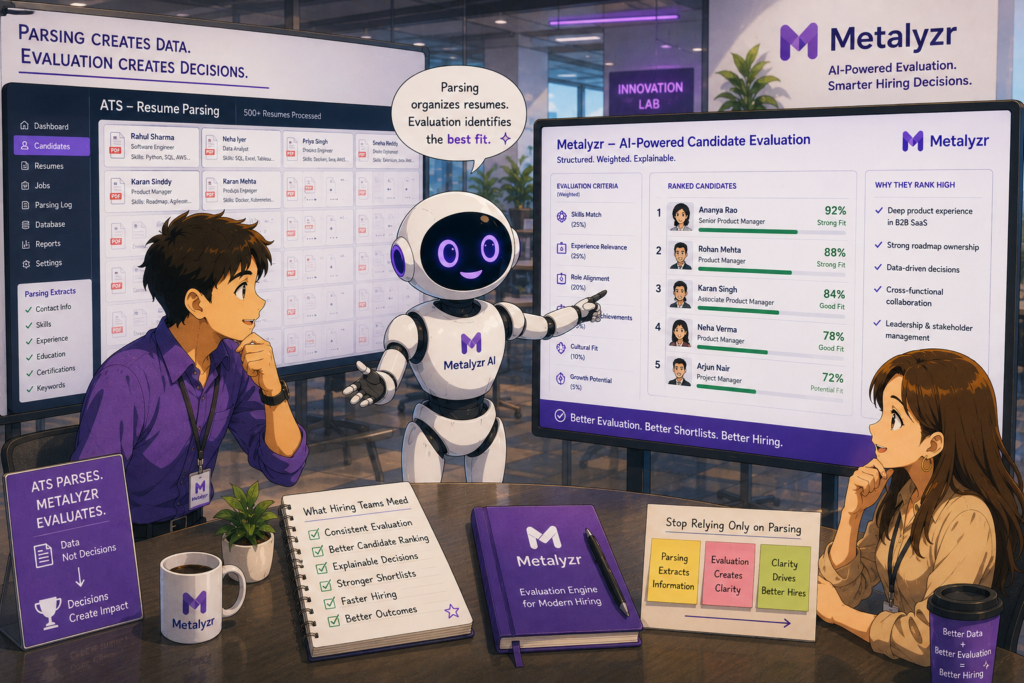
For the past decade, recruitment technology has focused heavily on one problem:
“How do we process resumes faster?”
The result has been an explosion of ATS systems, resume parsers, keyword extractors, and candidate databases.
And yet most hiring teams still struggle with the same question:
Which candidate should we hire?
That’s because parsing resumes and evaluating candidates are completely different problems.
One organizes information.
The other creates decisions.
Most recruitment technology solves the first problem.
Very few solutions solve the second.
And that distinction matters more than most recruiters realize.
Resume Parsing Was Never Designed To Make Hiring Decisions
A resume parser is useful.
It extracts:
- Name
- Contact information
- Skills
- Experience
- Education
- Certifications
This saves recruiters from manual data entry.
That is valuable.
But after the parser finishes its work, recruiters still face the hardest part of hiring:
Determining who deserves an interview.
The parser doesn’t answer that question.
It simply provides structured data.
The actual evaluation work still remains.
Why Faster Resume Processing Doesn’t Automatically Improve Hiring
Many organizations assume:
More automation = Better hiring.
But that’s rarely true.
Imagine receiving 500 resumes.
A parser organizes all 500 in seconds.
Great.
Now what?
Someone still needs to determine:
- Which candidates align best with the role
- Which experiences matter most
- Which skills are truly relevant
- Which candidates should be prioritized
The bottleneck hasn’t disappeared.
It simply moved.
Most teams mistake processing efficiency for decision efficiency.
They’re not the same thing.
The Real Problem Recruiters Face
Recruiters don’t struggle because resumes arrive unstructured.
They struggle because candidate evaluation is inconsistent.
Two recruiters reviewing the same resume may reach different conclusions.
Two hiring managers may rank candidates differently.
Even experienced recruiters often rely on intuition because there is no structured evaluation framework.
This creates:
- Inconsistent shortlists
- Delayed hiring decisions
- Candidate rejections
- Manager disagreement
- Extended hiring cycles
The challenge isn’t extracting information.
It’s interpreting it consistently.
If your ATS already parses resumes effectively but hiring decisions still take too long, the problem may not be resume processing.
Metalyzr helps recruiters evaluate, compare, and rank candidates using explainable AI-assisted scoring built specifically for hiring decisions.
Why Evaluation Is Becoming More Important Than Parsing
Modern ATS platforms have largely solved resume parsing.
Most systems can already identify:
- Skills
- Experience
- Keywords
- Education
- Certifications
The competitive advantage is no longer extracting information.
The advantage is understanding which information matters.
This is where structured evaluation becomes critical.
Recruiters need systems that answer:
“Why is Candidate A stronger than Candidate B?”
Not simply:
“What skills are listed on the resume?”
The Future Is Explainable Candidate Ranking
The next generation of recruiting technology focuses on ranking rather than parsing.
Instead of merely organizing candidates, these systems evaluate:
- Skill relevance
- Experience alignment
- Seniority fit
- Role suitability
- Evidence strength
- Hiring priorities
Most importantly, they explain their conclusions.
Recruiters gain transparency.
Hiring managers gain confidence.
Organizations make faster decisions.
What Smart Hiring Teams Are Doing Differently
Leading recruiting teams increasingly view their ATS as infrastructure.
Necessary.
But not strategic.
The strategic advantage comes from evaluation systems layered on top of candidate data.
These teams focus on:
Consistency
Every candidate is evaluated using the same criteria.
Transparency
Hiring managers understand why rankings exist.
Speed
Less manual comparison work.
Quality
Better shortlists reach stakeholders faster.
Final Thought
Resume parsing solved a problem from the last generation of recruiting.
Candidate evaluation is the challenge of the next generation.
The question is no longer:
“Can we organize resumes?”
Most systems already do that.
The real question is:
“Can we consistently identify the strongest candidates?”
That is where recruiting teams win.
And that is where the future of hiring technology is headed.
Ready To Move Beyond Resume Parsing?
See how Metalyzr helps recruiters evaluate and rank candidates with explainable AI-powered scoring designed for modern hiring teams.
Because organized resumes don’t create better hires. Better evaluation does.