
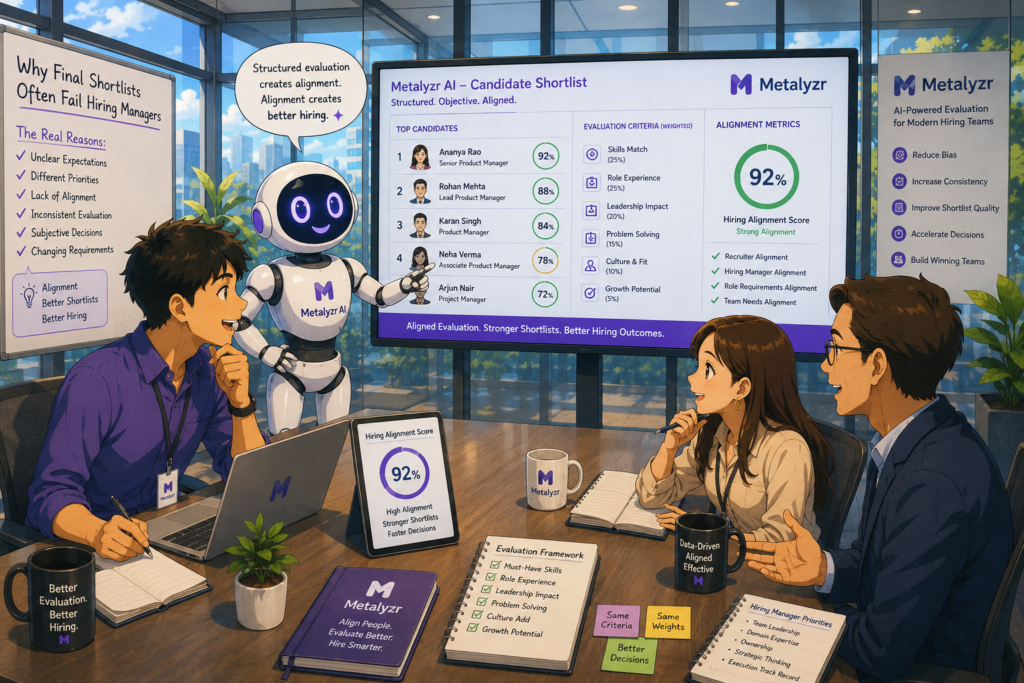
Most recruiters have experienced this situation:
You spend days sourcing candidates.
You screen resumes carefully.
You conduct recruiter interviews.
You build what looks like a strong shortlist.
Then the hiring manager rejects most of it.
The usual reaction is to blame sourcing quality.
But after studying hundreds of hiring workflows, I’ve noticed something surprising:
Most shortlist failures don’t happen because recruiters find bad candidates.
They happen because recruiters and hiring managers evaluate candidates using completely different criteria.
And the mismatch isn’t discovered until the very end.
The Hidden Problem Nobody Talks About
A recruiter might rank a candidate highly because:
- Strong industry experience
- Stable career progression
- Relevant technology exposure
- Excellent communication skills
Meanwhile, the hiring manager may prioritize:
- Experience with a very specific system
- Leading teams of a certain size
- Operating in a particular business environment
- Hands-on expertise in a niche skill
Both evaluations can be reasonable.
They’re simply measuring different things.
The result?
A shortlist that looks excellent to recruiting but weak to hiring leadership.
Want hiring managers and recruiters aligned before screening starts?
Metalyzr helps teams evaluate candidates against structured job requirements instead of subjective interpretations.
Why Resume Screening Alone Cannot Solve This
Most hiring workflows begin with resumes.
That sounds logical.
But resumes only tell part of the story.
Two candidates can appear nearly identical on paper:
- Same years of experience
- Same technologies
- Similar employers
Yet one may perfectly fit the role while the other struggles.
Why?
Because hiring decisions are often driven by context rather than keywords.
Questions like:
- What scale did they operate at?
- How much ownership did they have?
- What business problems did they solve?
- How independently did they work?
Rarely appear clearly in resumes.
This creates interpretation gaps between recruiters and hiring managers.
The Cost of Poor Alignment
When shortlists repeatedly miss expectations:
Hiring slows down
Recruiters restart sourcing cycles.
Candidate quality appears inconsistent
Even when sourcing efforts are strong.
Hiring managers lose trust
Future recruiter recommendations receive more scrutiny.
Candidate experience suffers
Strong candidates wait longer for decisions.
Many organizations mistakenly view this as a sourcing problem.
In reality, it is often an evaluation problem.
What High-Performing Hiring Teams Do Differently
The strongest recruiting organizations establish evaluation criteria before screening begins.
They agree on:
- Must-have requirements
- Nice-to-have requirements
- Experience weighting
- Skill weighting
- Decision thresholds
This creates consistency across stakeholders.
Instead of asking:
“Do we like this candidate?”
The discussion becomes:
“How well does this candidate match the role?”
That subtle shift dramatically improves shortlist quality.
Candidate Ranking Creates Alignment
The purpose of structured candidate ranking is not replacing recruiter judgment.
It’s creating a common framework for evaluation.
When everyone evaluates candidates against the same criteria:
- Recruiters understand expectations earlier
- Hiring managers receive more relevant shortlists
- Decisions become faster
- Quality becomes more consistent
Most importantly:
The hiring conversation becomes objective rather than subjective.
The Real Insight
The biggest hiring bottleneck isn’t finding candidates.
It’s agreeing on what “good” looks like.
Most organizations discover that too late.
The best organizations solve it before the first resume is reviewed.
That is why some recruiting teams consistently produce strong shortlists while others repeatedly restart searches.
The difference isn’t effort.
It’s evaluation alignment.
If your hiring managers frequently reject final shortlists, the issue may not be sourcing quality.
It may be inconsistent candidate evaluation.
Metalyzr helps recruiters rank, compare, and evaluate candidates using structured AI-assisted scoring designed for hiring teams.