
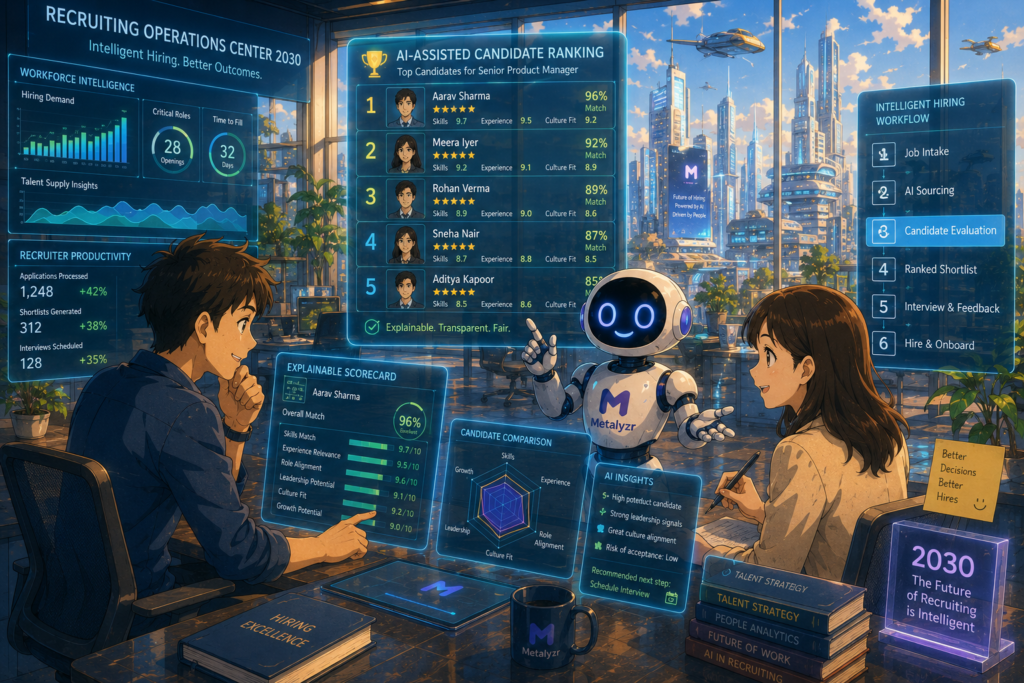
AI-assisted recruiting is no longer a future concept.
It’s already changing how recruiters evaluate candidates, build shortlists, and make hiring decisions.
Yet most conversations about AI recruiting still focus on automation.
That’s the wrong conversation.
The biggest impact of AI will not come from replacing recruiters.
It will come from helping recruiters make better decisions.
And by 2030, the recruiting teams that outperform their competitors will not necessarily have more recruiters.
They will have better hiring systems.
The Recruiting Problem Nobody Talks About
Most hiring teams already have access to candidates.
Job boards work.
LinkedIn works.
Referrals work.
Recruiters can generate applications.
The real challenge starts after applications arrive.
Suddenly recruiters face:
- Hundreds of resumes
- Conflicting hiring manager expectations
- Limited review time
- Inconsistent evaluation criteria
- Pressure to fill positions quickly
This is where recruitment becomes difficult.
Not because of talent scarcity.
Because of decision complexity.
AI Is Not Replacing Recruiters
Every few years a new technology arrives that promises to replace recruiters.
ATS platforms promised it.
Resume parsers promised it.
Automation platforms promised it.
None of them fundamentally changed recruiter decision making.
AI is different.
Not because it removes recruiters.
Because it enhances recruiter judgment.
The best AI recruiting systems help recruiters:
- Evaluate candidates faster
- Compare applicants objectively
- Surface hidden strengths
- Identify alignment with role requirements
- Create explainable shortlists
The recruiter still makes the decision.
The recruiter simply has better information.
The Future Is Candidate Ranking, Not Resume Filtering
Traditional hiring systems were designed around filtering.
Pass.
Fail.
Move forward.
Reject.
But recruiting isn’t a binary process.
Recruiters are constantly making comparative decisions.
Who is strongest?
Who aligns best?
Who deserves an interview first?
Who should move higher on the shortlist?
This is why candidate ranking will become one of the most important recruiting workflows by 2030.
Instead of filtering candidates out, recruiters will increasingly focus on prioritizing the best candidates first.
That creates faster and better hiring outcomes.
Modern recruiters don’t need more resumes.
They need better candidate visibility.
Metalyzr helps recruiters evaluate, compare, and rank candidates using structured AI-assisted scoring so hiring decisions become faster, more consistent, and easier to explain.
See how AI-assisted candidate ranking works with Metalyzr.
Explore smarter candidate evaluation:
Recruiters Will Become Hiring Strategists
One major shift is already underway.
Recruiters are spending less time on administration and more time influencing hiring decisions.
By 2030, recruiters will increasingly focus on:
- Hiring quality
- Candidate experience
- Hiring manager alignment
- Workforce planning
- Talent intelligence
AI will handle much of the repetitive evaluation work.
Recruiters will spend more time applying judgment where it matters most.
This is similar to what happened in finance.
Technology didn’t eliminate financial analysts.
It amplified the best analysts.
Recruitment is heading in the same direction.
Explainability Will Matter More Than Automation
Many hiring leaders worry about AI making decisions.
The concern is understandable.
But the future isn’t black-box hiring.
The future is explainable hiring.
Recruiters need to understand:
- Why a candidate scored highly
- Why candidates were ranked differently
- Which criteria influenced evaluation
- How hiring recommendations were generated
The recruiting systems that win over the next decade will not simply automate decisions.
They will explain decisions.
The Most Successful Recruiting Teams Will Combine Human Judgment and AI
Recruitment has always been part science and part human judgment.
That won’t change.
What will change is the quality of information available to recruiters.
AI can process large candidate pools.
Recruiters can evaluate nuance, context, and organizational fit.
Together they create stronger hiring outcomes than either can achieve independently.
The future is not human versus AI.
The future is human plus AI.
What Recruitment Might Look Like in 2030
A recruiter uploads a job description.
Candidates are automatically evaluated against structured criteria.
Shortlists are generated with transparent ranking explanations.
Hiring managers see alignment scores.
Interview feedback is consolidated automatically.
Candidate engagement insights are surfaced in real time.
The recruiter spends less time reviewing resumes and more time making strategic hiring decisions.
That future is closer than most organizations realize.
In many ways, it has already begun.
Final Thoughts
AI-assisted recruiting is not about replacing recruiters.
It is about helping recruiters make better decisions faster.
The organizations that embrace AI intelligently will not simply hire more efficiently.
They will hire more accurately.
And in a world where talent remains the most important competitive advantage, better hiring decisions will always outperform faster hiring processes.
Ready for the Future of Recruiting?
Metalyzr helps recruiters rank, evaluate, and compare candidates using explainable AI-assisted scoring built specifically for modern hiring teams.
Try Metalyzr and experience the future of candidate evaluation today.