
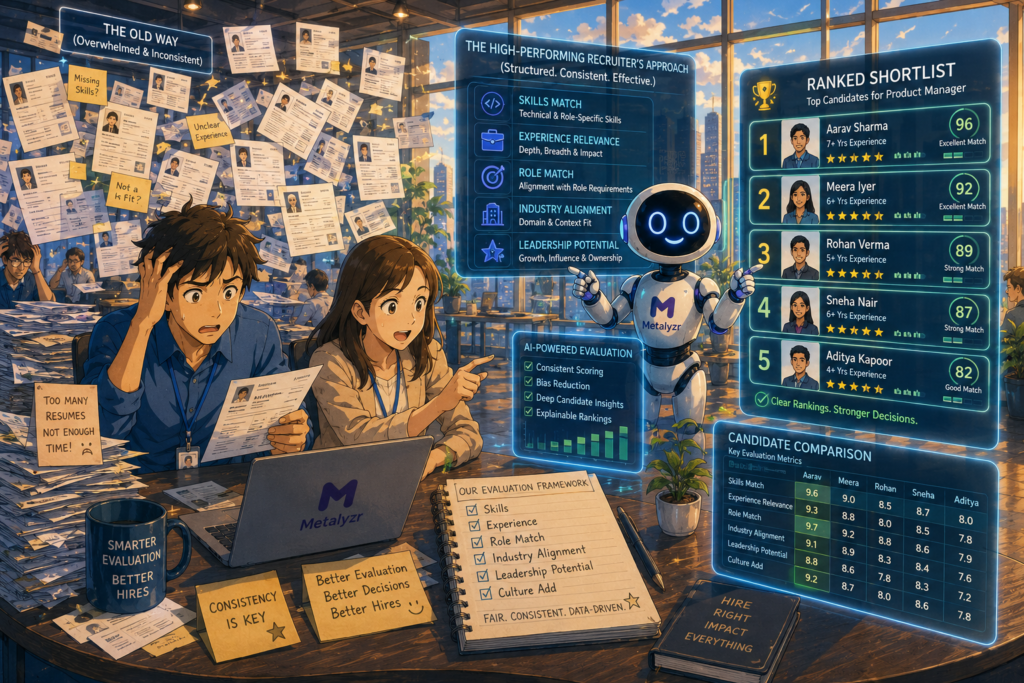
Most recruiters don’t have an applicant shortage.
They have a candidate evaluation problem.
The difference between average recruiters and high-performing recruiters is rarely sourcing ability. It is usually the ability to evaluate candidates consistently, objectively, and efficiently.
In today’s hiring environment, candidate evaluation has become one of the most important recruiter skills. Application volumes continue to rise, hiring managers expect faster shortlists, and recruiters are under pressure to identify quality talent without slowing down the hiring process.
Yet many hiring teams still evaluate candidates using methods that were designed for a completely different hiring landscape.
And that creates a problem.
The best recruiters are not necessarily reviewing more resumes.
They are evaluating candidates differently.
Most Recruiters Evaluate Candidates One Resume at a Time
This sounds logical.
A candidate applies.
The recruiter reviews the resume.
The recruiter decides whether the candidate should move forward.
Repeat.
The problem is that this approach doesn’t scale.
When recruiters review candidates individually, decisions become heavily influenced by:
- Resume formatting
- Recent candidate comparisons
- Time pressure
- Personal preferences
- Hiring manager assumptions
Two candidates with nearly identical qualifications can receive completely different outcomes depending on when they were reviewed.
That isn’t candidate evaluation.
That’s decision variability.
High-Performing Recruiters Compare Candidates Against Defined Criteria
The strongest recruiters start with evaluation criteria before they start reviewing resumes.
Instead of asking:
“Do I like this candidate?”
They ask:
“How well does this candidate align with the requirements of the role?”
The difference may seem small.
In practice, it changes everything.
Structured evaluation helps recruiters focus on:
- Relevant experience
- Required skills
- Industry alignment
- Role-specific competencies
- Hiring manager priorities
This creates consistency across every candidate reviewed.
And consistency is what improves hiring quality.
The fastest way to improve candidate evaluation is to make every candidate comparison follow the same framework.
Metalyzr helps recruiters rank, compare, and evaluate candidates using structured AI-assisted scoring so hiring decisions become more consistent and easier to explain.
Try Metalyzr and see how structured candidate evaluation changes your shortlist quality.
Explore smarter candidate evaluation:
The Best Recruiters Focus on Ranking, Not Filtering
Many recruitment workflows are still built around filtering.
Candidates either pass or fail.
Move forward or reject.
The issue is that hiring decisions are rarely binary.
A recruiter’s job is not simply to remove candidates.
It is to identify the strongest candidates relative to everyone else in the pipeline.
This is why ranking becomes so important.
High-performing recruiters don’t ask:
“Does this candidate qualify?”
They ask:
“Where does this candidate rank compared to the rest of the applicant pool?”
That shift dramatically improves shortlist quality.
Candidate Evaluation Becomes Harder as Volume Increases
Most hiring systems break down when application volume grows.
At 20 resumes, manual evaluation works.
At 200 resumes, quality starts to decline.
At 2,000 resumes, consistency often disappears entirely.
Recruiters become overwhelmed.
Hiring managers receive inconsistent shortlists.
Strong candidates are overlooked.
The problem isn’t recruiter capability.
The problem is process design.
Without structured evaluation systems, candidate quality becomes increasingly difficult to assess at scale.
Why Structured Evaluation Produces Better Hiring Outcomes
Organizations that consistently make strong hiring decisions usually have one thing in common:
They reduce subjectivity.
Structured candidate evaluation creates:
- Better hiring manager alignment
- Faster shortlist creation
- More consistent decisions
- Clearer candidate comparisons
- Improved hiring confidence
Most importantly, it reduces the likelihood of missing strong candidates simply because they were reviewed at the wrong time.
The Future of Candidate Evaluation
Recruitment is moving away from resume filtering and toward candidate ranking.
The highest-performing recruiters are already adopting workflows that emphasize:
- Structured evaluation
- Candidate comparison
- Ranking systems
- Explainable scoring
- AI-assisted hiring support
The goal is not replacing recruiter judgment.
The goal is improving recruiter judgment.
Because the recruiters who consistently hire great people are rarely the ones reviewing the most resumes.
They are the ones evaluating candidates most effectively.
Final Thoughts
Candidate evaluation is quickly becoming the most important competitive advantage in recruitment.
Application volume will continue increasing.
Hiring complexity will continue increasing.
The recruiters who succeed will not be those who work harder.
They will be those who build better evaluation systems.
And in the future of hiring, better evaluation will outperform better intuition every time.
Ready to Improve Candidate Evaluation?
See how Metalyzr helps recruiters rank, compare, and evaluate candidates using structured AI-assisted scoring and explainable candidate rankings.
Try Metalyzr today and build stronger shortlists with greater confidence.