
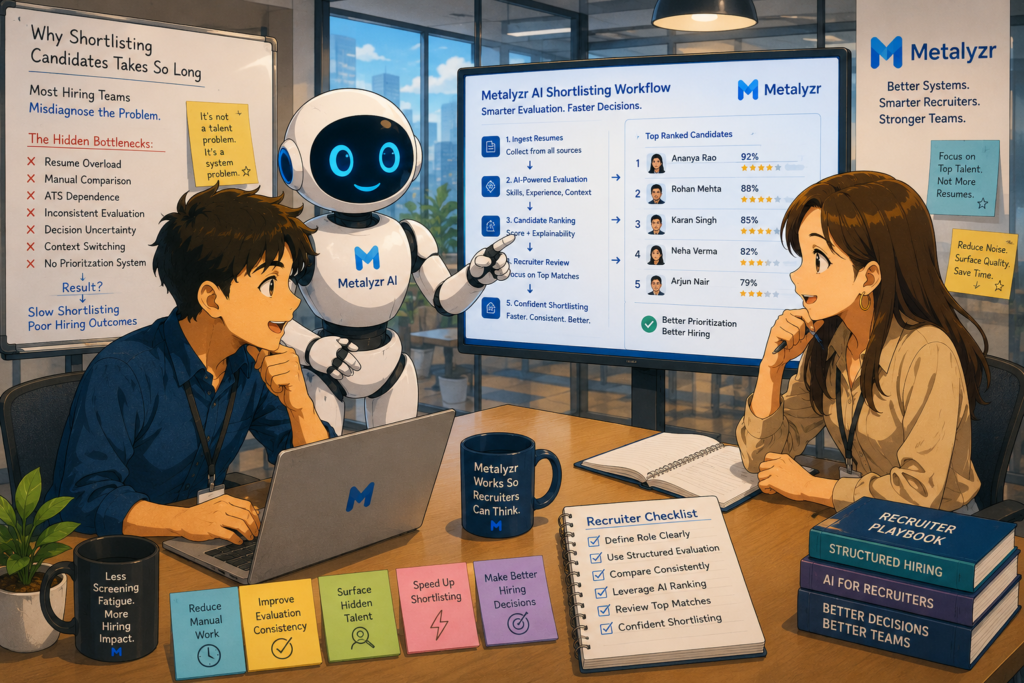
Most hiring teams think candidate shortlisting takes too long because recruiters are overloaded.
That is only partially true.
The deeper issue is this:
Most recruitment workflows were never designed for high-volume decision-making.
Modern recruiters are expected to:
- process hundreds of resumes
- identify top-fit candidates quickly
- justify hiring decisions
- avoid bias
- maintain consistency
- move fast without sacrificing quality
But the systems supporting them are often fragmented, manual, and reactive.
This is why shortlisting delays are becoming one of the biggest operational bottlenecks in modern hiring.
And AI is exposing just how inefficient traditional hiring workflows really are.
The Resume Volume Problem Is Real
The average recruiter today receives significantly more applications than hiring systems were originally designed to handle.
Especially for:
- remote jobs
- startup hiring
- tech roles
- mid-level management
- leadership openings
The result?
Recruiters spend enormous amounts of time:
- scanning resumes
- comparing candidates manually
- switching between tabs
- exporting spreadsheets
- reviewing ATS-filtered profiles
- re-checking hiring decisions
Eventually, hiring slows down.
Not because recruiters are incapable.
Because the process itself does not scale.
Most Hiring Delays Are Actually Decision Delays
This is the part many organizations misunderstand.
The real bottleneck is rarely resume collection.
It is candidate prioritization.
When recruiters cannot confidently determine:
- who deserves attention first
- which candidates are strongest-fit
- why one candidate ranks above another
- whether hidden-fit candidates are being missed
the entire hiring process slows down.
Decision uncertainty creates operational drag.
Why ATS Systems Alone Cannot Solve This Problem
Applicant Tracking Systems are useful operational tools.
But most ATS platforms were not built to provide deep candidate intelligence.
They help organize hiring pipelines.
They do not necessarily improve evaluation quality.
That is why many recruiters still:
- manually review resumes
- create side spreadsheets
- compare profiles outside the ATS
- rely on instinct-driven shortlisting
These workarounds signal an important issue:
Recruiters do not fully trust the prioritization layer.
The Hidden Cost of Slow Shortlisting
Most companies underestimate how expensive slow shortlisting becomes.
Every hiring delay can create:
- candidate drop-off
- increased recruiter fatigue
- delayed interviews
- weaker hiring pipelines
- stakeholder frustration
- lost productivity
- bad hiring decisions made under pressure
Top candidates rarely wait long.
Slow evaluation often means losing strongest-fit talent first.
Still manually reviewing resumes one by one?
Metalyzr helps recruiters rank candidates faster using explainable AI-assisted evaluation built for structured hiring workflows and better prioritization.
Why Recruiters Need Evaluation Systems — Not More Admin Tools
The recruitment software market has become crowded with:
- ATS platforms
- workflow managers
- sourcing tools
- scheduling systems
- communication tools
But many platforms still fail to solve the recruiter’s biggest operational problem:
“How do I confidently prioritize the right candidates faster?”
That is fundamentally an evaluation problem.
Not an administration problem.
AI Candidate Ranking Changes the Workflow Completely
Modern AI-assisted hiring systems help recruiters:
- reduce comparison fatigue
- improve ranking consistency
- identify strong-fit candidates faster
- surface hidden talent
- standardize evaluation quality
- reduce repetitive screening work
Importantly, recruiters remain fully in control.
AI should support recruiter judgment.
Not replace it.
The Strongest Hiring Teams Will Become Structured Decision Systems
The future of recruitment is shifting away from:
- instinct-only hiring
- resume overload
- spreadsheet comparisons
- keyword dependency
And toward:
- structured evaluation
- explainable scoring
- AI-assisted ranking
- recruiter productivity systems
- decision-support workflows
The companies that adopt structured hiring systems earlier will likely hire better over time.
Because hiring quality compounds.
Why Explainability Matters in Candidate Ranking
Many recruiters distrust AI hiring systems for one reason:
Black-box scoring.
If recruiters cannot understand:
- why a candidate ranked highly
- which skills influenced scoring
- how evaluation logic works
they will not trust the platform.
Explainability is critical.
Good recruiter AI should help recruiters:
- understand decisions faster
- defend hiring recommendations
- reduce uncertainty
- improve confidence in shortlisting
That is where modern candidate ranking systems become valuable.
The Real Goal Is Better Hiring Focus
The future is not about recruiters reviewing more resumes.
It is about recruiters focusing attention where it matters most.
That shift changes everything.
Because the best recruiters are not simply faster.
They are systematic.
Final Thoughts
Candidate shortlisting takes too long because most hiring workflows were never designed for intelligent prioritization at scale.
Modern hiring requires:
- structured evaluation
- recruiter productivity systems
- explainable AI support
- consistent candidate ranking
The organizations that modernize these workflows early will likely gain a major hiring advantage over the next few years.
If your hiring team still depends heavily on manual resume review, spreadsheet comparisons, or instinct-driven prioritization, now is the time to modernize your evaluation workflow.
Metalyzr helps recruiters shortlist candidates faster using explainable AI-assisted ranking designed for modern hiring teams.