
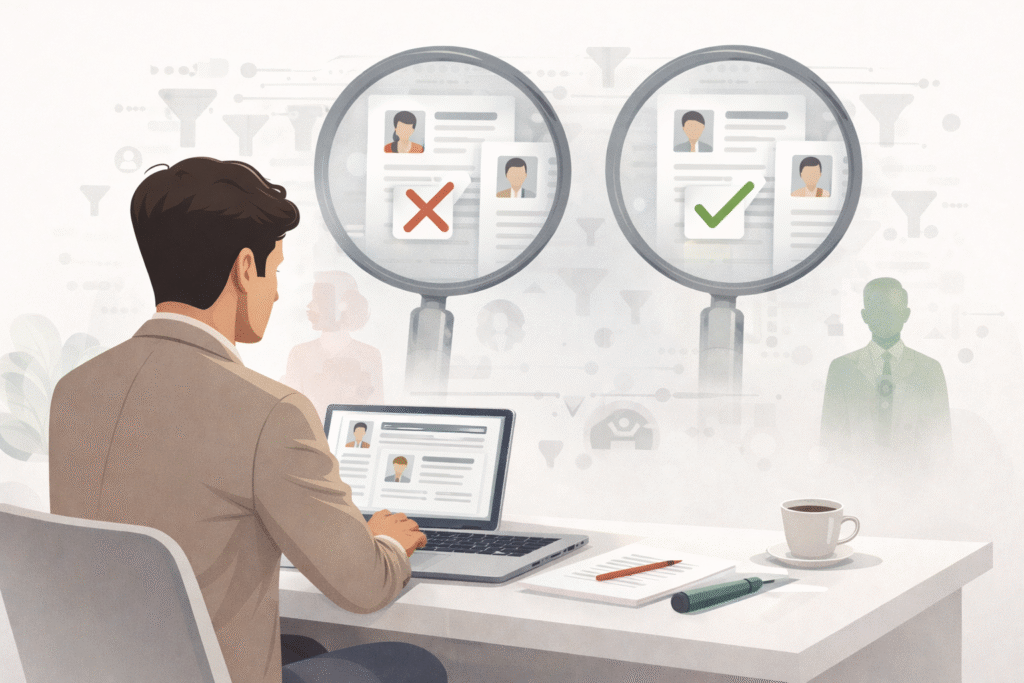
Recruiters with long experience rarely set out to introduce bias into hiring. Most actively try to reduce it.
Yet over the years, many have come to a difficult realization: bias does not always come from people. Increasingly, it is introduced quietly by the systems designed to make hiring more “objective.”
Applicant Tracking Systems, particularly those built around rigid filters, can create bias without intent, visibility, or accountability.
Where Bias Enters the Screening Process
Bias in ATS-driven screening does not appear as an explicit rule.
It enters indirectly through:
- Keyword-heavy job descriptions
- Static screening criteria
- Hard thresholds that ignore context
- Filters optimized for similarity, not relevance
Each individual rule appears neutral.
Together, they systematically favor certain profiles over others.
The Difference Between Intent and Outcome
Most recruiters configure ATS filters with good intentions:
- To manage volume
- To maintain consistency
- To align with hiring manager expectations
However, experienced recruiters observe that outcomes matter more than intent.
Filters tend to advantage candidates who:
- Come from familiar companies
- Use dominant industry terminology
- Follow conventional career paths
- Have resumes optimized for systems
They disadvantage candidates who:
- Transition across domains
- Use alternative terminology
- Come from smaller or regional organizations
- Emphasize outcomes over tools
The bias is structural, not personal.
Why This Bias Is Hard to Detect
Recruiters rarely see the bias because:
- Rejected profiles are hidden
- Filter logic is rarely audited
- Results look “clean” and manageable
- Everyone downstream sees the same shortlist
Over time, the filtered pool becomes accepted as the market reality.
Very few teams ever ask:
“Who did we never see?”
Bias Disguised as Consistency
One of the most misleading ideas in hiring is that consistency equals fairness.
Applying the same flawed filter consistently does not make it fair.
It simply reproduces the same bias at scale.
Experienced recruiters have seen how this leads to:
- Teams that look increasingly similar
- Reduced diversity of thought
- Missed unconventional but high-potential candidates
The system appears neutral while quietly narrowing opportunity.
👉 See How Screening Rules Shape Hiring Outcomes
Why Recruiters Are Often Blamed Instead
When bias surfaces later—through audits, complaints, or poor hiring outcomes—the focus often shifts to recruiter behavior.
But recruiters are working within systems they did not design.
They:
- Inherit predefined filters
- Trust system outputs
- Operate under time and volume pressure
Blaming individuals misses the systemic source of the problem.
The Long-Term Impact on Hiring Quality
Bias introduced at the screening layer compounds over time.
Organizations begin to:
- Hire from narrower talent pools
- Lose adaptability and creativity
- Mistake homogeneity for cultural fit
Because nothing appears broken operationally, these effects go unchallenged.
Closing Perspective
Recruiters with decades of experience increasingly recognize a subtle but critical truth:
Bias does not only come from human judgment.
It also comes from the rules we choose not to question.
Any screening system that prioritizes rigid filters over thoughtful evaluation will continue to introduce bias—quietly, consistently, and without awareness.
Reducing bias requires more than good intentions.
It requires rethinking how screening decisions are made.
🔍 Rethink How Fair Screening Should Work